
Artist / Nicolas Bortone
2025 / Unreal Engine + Cinematic
SCANN Research Facility
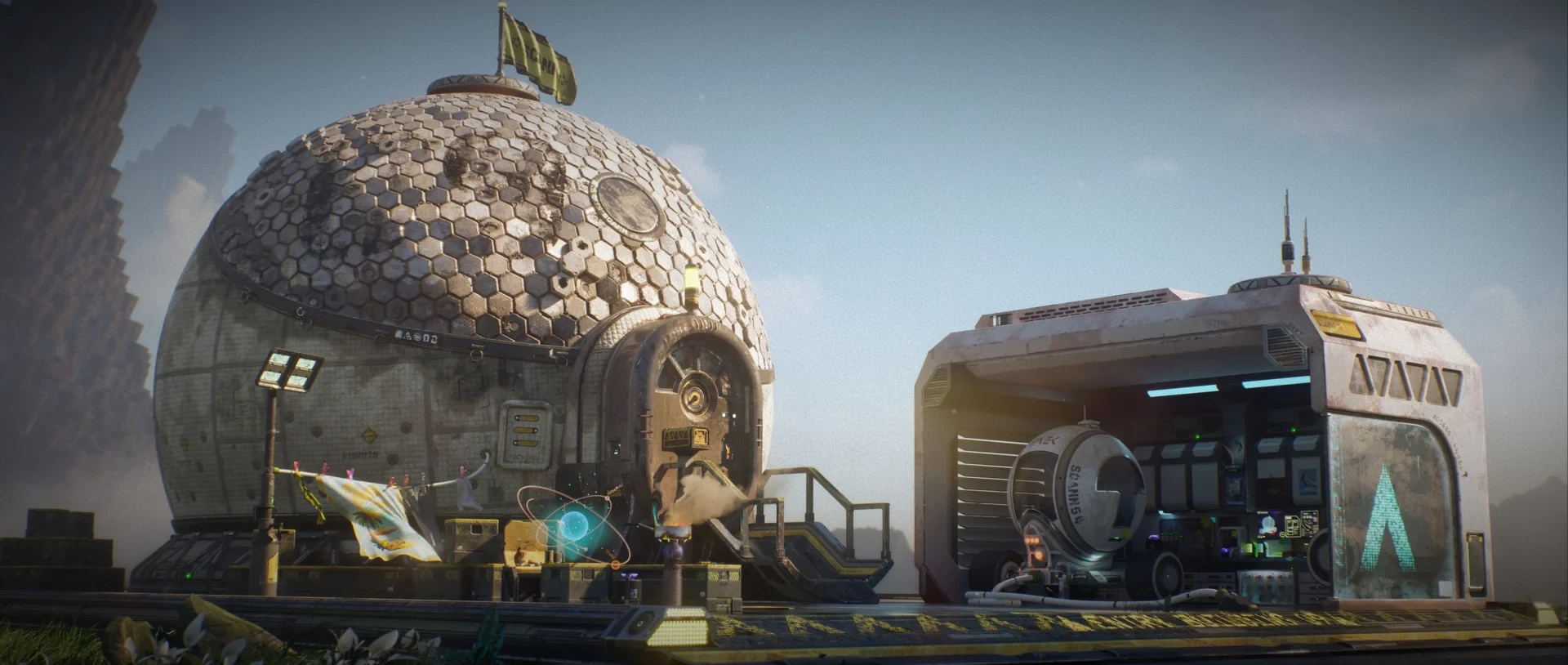
A remote research facility where two contrasting structures, working labs and a holographic display make the station feel in use, built in Unreal Engine.
Artwork / Nicolas Bortone
Explore the galleryProject profile
Production snapshot
SCANN is a roadside research station in a rocky landscape: a weathered hexagonal dome beside an open research cabin, with field supplies, a cooking setup and an orbital hologram outside. Nicolas Bortone built it in Unreal Engine; the gallery moves from the road to the dome’s surface, the workbench and the hologram.
- Services
- 3D Environments, Texturing & Materials, Animation & VFX
- Platforms
- Unreal Engine, Cinematic
- Year
- 2025
- Made with Unreal Engine, Blender, Plasticity, ZBrush, Substance 3D Painter, Substance 3D Designer, Marmoset Toolbag, GeoGen and EmberGen.
- Concept: “capsule house” by WOOKUN (Sangtaek Woo)
- Cat model: Radik Bilalov, from Fab

Story
From direction to finished environment
Challenge
Create a readable research facility that balances broad worldbuilding with material detail, believable workspaces, and moments of discovery.
Approach
A pair of contrasting structures anchors the scene while props, decals, screens, and animated holographic elements make the station feel actively used.
Result
A station that feels in use rather than staged: the architecture reads at a distance, while the workspaces, field equipment and hologram reward the closer views.

Visual gallery
Explore the environment
01 / 3 frames
Facility & architecture
A wide view of the roadside station, followed by a closer composition and a study of the dome's weathered hexagonal surface.
02 / 2 frames
Life at the facility
Small equipment studies bring the station down to a human scale: a worn box beside the entrance and a cooking setup among the field supplies.
03 / 3 frames
Research & technology
The workspace in context, its close-up instruments, and the outdoor hologram display connect the station's practical equipment with its science-fiction setting.
Making of
How it was made
High-to-low poly props
The props were modeled in Blender and Plasticity, pushed further in ZBrush with damage and extra detail, then baked down to game-ready meshes. Some details were baked on their own and stamped in Substance 3D Painter as alphas.
Materials made for the scene
Tiling materials for the panels and plating, hexagonal tiles included, were authored in Substance 3D Designer.
One master material, painted by hand
Vertex colors paint up to four material layers across the architecture. Paired layers share their UV offsets, so the grimier version of a surface stays lined up with the clean one beneath it.
Color variation for free
A mask packed into the blue channel of an existing texture lets each prop pick its color at random from a 3×3 map based on its position: more variety, without extra textures or draw calls.
Lights that flicker, not blink
The faulty lights ramp up and fade out along a float curve instead of snapping on and off, with emissive limits and variation so no two flicker in sync.
Terrain and steam
The coastline in the background was shaped with GeoGen’s spline tool and layered with materials in Unreal through an RGB mask. The steam over the cooking pot is an EmberGen simulation that uses the scene’s own mesh as its collider.
Start a project
Need a worldlike this?
Tell us about your environment, the engine and formats it needs, and the mood you are after. We build complete worlds, props and materials for games and real-time projects.