
Artist / Nicolas Bortone
2025 / Unreal Engine + Cinematic
FUYOH Restaurant
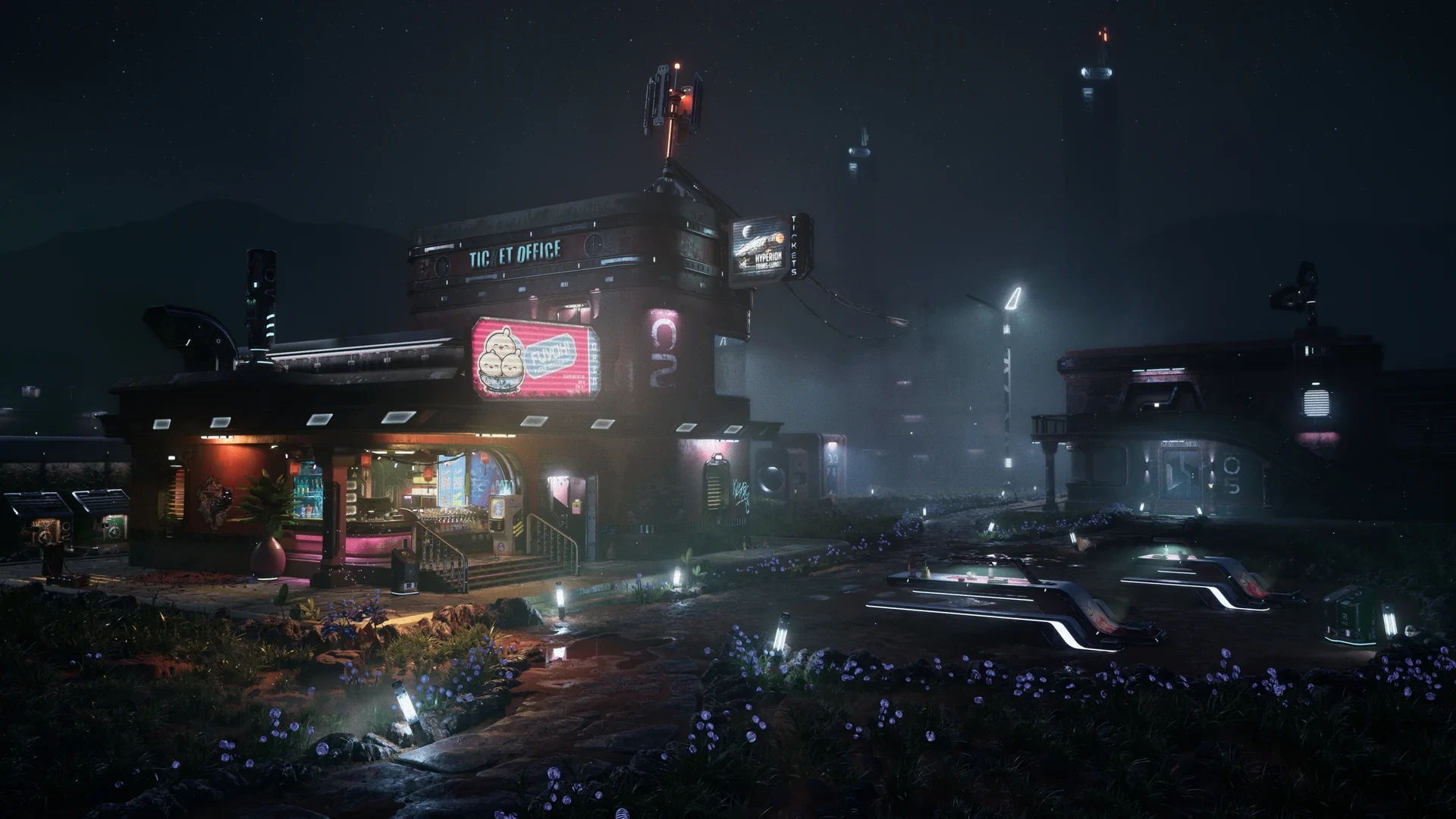
A rain-soaked sci-fi restaurant at night, lit by neon signage and path lights and built as a cinematic Unreal Engine environment.
Artwork / Nicolas Bortone
Explore the galleryProject profile
Production snapshot
FUYOH is a food counter on the edge of a small outpost, with a rounded neighboring building, a ticket office and a rooftop beacon along a misty path of purple flowers and path lights. Nicolas Bortone built the scene in Unreal Engine, from the modular buildings and wall sections to the signs, props and foliage; the gallery ends with the complete kit.
- Services
- 3D Environments, Texturing & Materials, Animation & VFX
- Platforms
- Unreal Engine, Cinematic
- Year
- 2025
- Made with Unreal Engine, Blender, ZBrush, Substance 3D Painter, Substance 3D Designer, Marmoset Toolbag, RealityScan, Gaea, GeoGen and EmberGen.
- Concept: “A Night on PhotosIV” by Klaus Pillon
- Prop inspiration: “Swarms – Props” by Quentin Ghion and “prop design 04” by ZHU George

Story
From direction to finished environment
Challenge
Build a rain-soaked sci-fi restaurant whose architecture, lighting, foliage, and signage could carry both intimate details and a wide cinematic reveal.
Approach
The environment was developed as a layered production scene: modular structures established the silhouette, wet materials and fog set the atmosphere, and focused practical light guided every camera move.
Result
A restaurant that reads from the wide reveal down to the food counter. The warm counter anchors every shot, and the kit behind the scene is broken out piece by piece.

Visual gallery
Explore the environment
01 / 4 frames
The restaurant after dark
From the complete scene to the storefront, neighboring buildings, and rooftop signage. Cool fog and path lights connect the outpost around the warm food counter.
02 / 4 frames
Light, life & surface detail
A closer look at the stocked counter, worn architecture, wet vegetation, and small pools of light that give the environment a lived-in feel.
03 / 1 frame
Environment asset breakdown
The buildings, wall sections, signs, lights, props, and foliage shown together as the pieces behind the finished market scene.
Making of
How it was made
Procedural set dressing
PCG graphs place the road lights, rock lines, hanging cables, grass and footprints, with parameters exposed for art direction. They work together: the road and the rocks clear the grass beneath them, so a change to the layout updates the whole scene.
Tools built for the job
A tagging tool inside Unreal applies and removes tags across many actors at once and selects them in groups, and a small Blender add-on written for this project turns repetitive modeling steps into one click.
Lights and signs with a life of their own
Each light pylon takes a slightly different color temperature and brightness, and some flicker on a timeline. The neon letters flicker by panning their UVs across a striped map, and the ad screens swap images through a dynamic material.
One master material for the buildings
Up to four vertex-painted layers with adjustable transitions, Substance-baked RGB masks for extra detail, puddles, cell bombing, and a choice of parallax occlusion mapping or Nanite. Each layer can align to the world or follow the UVs.
Trim sheet and decal atlases
A single trim sheet and decal atlas detail many meshes at once, applied as floating strips and planes. Their emissive parts were baked with bounce light, so glowing details spill a soft light onto the surface around them.
Food and bottles
The food on the counter was modeled in Blender (geometry nodes for the rice) and ZBrush, then baked into a single texture set: 17 million triangles down to 13,000. The bottles, 185,000 down to 8,300, include a primitivo from the artist’s family land.
Start a project
Need a worldlike this?
Tell us about your environment, the engine and formats it needs, and the mood you are after. We build complete worlds, props and materials for games and real-time projects.